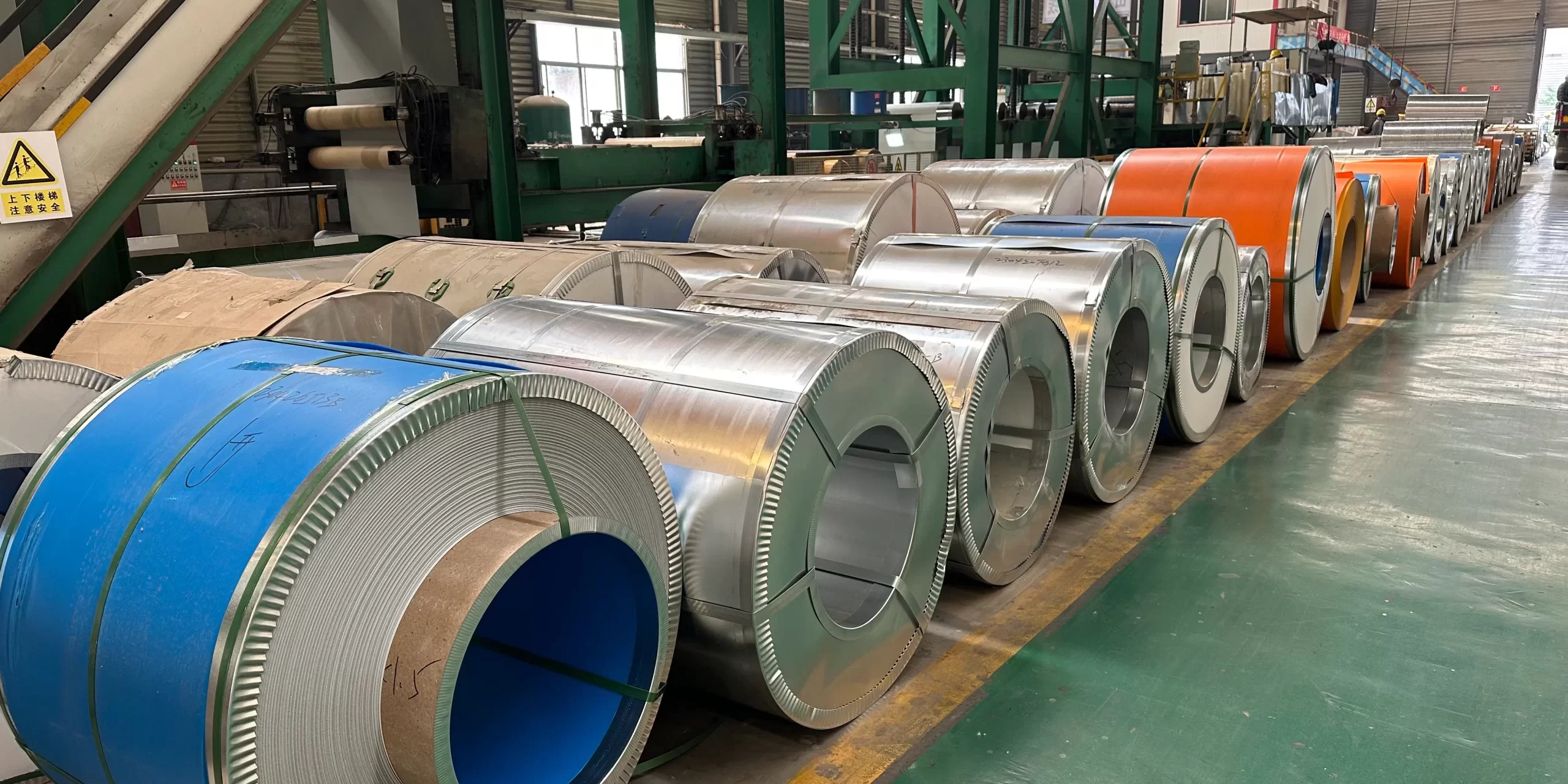
A galvanized steel coil is a continuous strip of carbon steel that has been coated with a protective layer of zinc and wound into a roll for efficient storage, transport, and downstream processing. The zinc coating shields the steel base from moisture and oxygen and, even when scratched, continues to protect exposed steel through sacrificial (cathodic) action. Because it combines the strength and formability of steel with long-lasting corrosion resistance at a moderate cost, galvanized coil—often abbreviated as GI coil—is one of the most widely used flat steel products in construction, HVAC, appliances, automotive parts, and agricultural equipment.
This guide explains how galvanized steel coil is classified and produced, which standards and grades matter, how to read coating designations, what specifications are common, and what to check before placing an order.
What Is a Galvanized Steel Coil?
Galvanizing is the process of applying a metallic zinc coating to steel. When the coated strip is supplied in roll form rather than cut sheets, it is called a galvanized steel coil. Coils are the standard delivery form for roll-forming lines, slitting lines, cut-to-length lines, and stamping presses, since they allow continuous feeding and reduce handling losses.
The substrate is usually low-carbon steel. Thinner material (roughly 0.12 mm to 2.0 mm) is normally produced from cold-rolled full-hard strip, while heavier gauges (about 2.0 mm and above) are often made from hot-rolled, pickled strip. The zinc layer protects the steel in two ways:
Barrier protection:
- The zinc layer physically separates the steel from water, oxygen, and pollutants.
Sacrificial protection:
- Zinc is more electrochemically active than iron. Where the coating is scratched or at sheared edges, the surrounding zinc corrodes preferentially and slows rust formation on the exposed steel.
Hot-Dip Galvanized Steel Coil
Hot-dip galvanized (HDG) coil is produced by passing steel strip through a bath of molten zinc on a continuous galvanizing line. It is the most common type on the market because it offers a relatively thick coating—typically from about 40 g/m² up to 600 g/m² total on both sides—at an economical cost. Hot-dip coil is the standard choice for roofing and wall cladding substrates, purlins, cable trays, ductwork, and outdoor structures.
Electro-Galvanized Steel Coil
Electro-galvanized (EG) coil is coated by electrolytic deposition of zinc in a plating cell. The coating is thinner and very uniform, and the surface is smooth with no visible spangle, making it well suited to painting, powder coating, and precise stamping. Typical uses include appliance housings, computer cases, electrical cabinets, and interior automotive parts. Because the coating weight is lower, electro-galvanized coil is not usually selected for long-term outdoor exposure without additional painting.
Galvannealed and Other Zinc-Based Coatings
Galvannealed (GA) coil is hot-dip galvanized strip that is reheated immediately after coating so that iron diffuses into the zinc, forming a matte gray zinc-iron alloy layer. It offers excellent paint adhesion and good spot weldability, which is why it is widely used for automotive body panels. In addition, zinc-aluminum-magnesium (ZM) coatings have become a popular option where improved cut-edge and surface corrosion performance is needed. Aluminum-zinc coated coil (often called Galvalume, with about 55% aluminum) is a related product but is technically an aluminum-zinc coating rather than a galvanized zinc coating, and it follows separate standards.
Main Standards and Grades for Galvanized Steel Coil
Galvanized coil is produced to several national and international standards. Each standard defines grades by forming capability or minimum yield strength, plus a separate coating designation. When requesting quotations, always state both the steel grade and the coating mass.
| Standard | Region | Commercial / Forming Grades | Structural Grades | Coating Designation Examples |
| ASTM A653 / A653M | USA | CS Type A/B, FS, DDS, EDDS | SS Grade 33, 37, 40, 50, 80 | G30, G60, G90 (imperial); Z180, Z275 (metric) |
| EN 10346 | Europe | DX51D, DX52D, DX53D, DX54D | S220GD, S250GD, S280GD, S320GD, S350GD, S550GD | Z100, Z140, Z200, Z275, Z350 |
| JIS G3302 | Japan | SGCC, SGCD1–SGCD4 | SGC340, SGC400, SGC440, SGC490, SGC570 | Z08, Z12, Z18, Z27 |
| GB/T 2518 | China | DX51D+Z, DX52D+Z, DX53D+Z | S250GD+Z, S350GD+Z, S550GD+Z | Z80 to Z275 and above |
| ASTM A879 / EN 10152 / JIS G3313 | Various | Electro-galvanized grades (e.g., DC01+ZE, SECC) | — | Coating mass per side, in g/m² |
Commercial and Forming Grades
Commercial quality grades such as DX51D+Z, SGCC, and ASTM A653 CS Type B are suitable for general bending, roll forming, and light stamping. As the grade number increases toward DX53D or DX54D (or DDS and EDDS under ASTM), the steel becomes softer and more ductile, supporting deeper drawing operations such as appliance panels and complex pressed parts. Forming grades are specified mainly by drawability, not guaranteed yield strength.
Structural Grades
Structural grades guarantee a minimum yield strength and are used where the galvanized coil will carry loads. For example, S350GD+Z under EN 10346 has a minimum yield strength of 350 MPa, while ASTM A653 SS Grade 50 has a minimum yield strength of 50 ksi (about 340 MPa). These grades are common for roll-formed purlins, light-gauge steel framing, structural decking, and solar mounting systems. High-strength grades such as S550GD or SS Grade 80 provide very high strength in thin gauges but have limited elongation, so tight bends should be checked against the supplier’s forming guidance.
Zinc Coating Mass and Surface Finishes
Coating mass is the single most important factor affecting the service life of galvanized steel coil. It is also a frequent source of misunderstanding between buyers and suppliers, so it is worth understanding how coating designations work.
How to Read Coating Designations
In metric standards, the “Z” number usually indicates the total minimum coating mass on both sides in grams per square meter. For example, Z275 means at least 275 g/m² total, or roughly 137.5 g/m² per side. In the ASTM imperial system, G90 means 0.90 oz/ft² total on both sides, which is approximately equivalent to Z275; G60 is close to Z180, and G30 is close to Z90.
A useful conversion for hot-dip zinc: about 7.14 g/m² of zinc equals 1 µm of coating thickness on one side. A Z275 coating therefore corresponds to roughly 19 µm of zinc per side. For electro-galvanized products, coating mass is often expressed per side (for example, 20/20 g/m²), so it is important to confirm whether a figure refers to one side or both sides.
Spangle Types
Spangle is the visible crystalline pattern of zinc on the surface of hot-dip galvanized coil.
Regular spangle:
- Large, visible flower-like crystals; economical and common for unpainted construction products.
Minimized spangle:
- Small, fine crystals produced by controlled cooling; preferred when the surface will be painted.
Zero spangle:
- A smooth, uniform surface with no visible crystals, widely used as a substrate for pre-painted coil and appliance applications.
Surface Treatments
After coating, the strip normally receives a surface treatment to prevent “white rust” (zinc corrosion products that form when the coil is exposed to trapped moisture during storage and shipping). Common options include chemical passivation (chromate or chromate-free), oiling, passivation plus oiling, anti-fingerprint coating, and phosphating. If the coil will be painted or powder coated, the surface treatment must be compatible with the paint system, so it should be agreed with both the coating applicator and the steel supplier in advance.
How Galvanized Steel Coil Is Produced
Most hot-dip galvanized coil is made on a continuous galvanizing line (CGL), a highly automated process that runs steel strip at speeds that can exceed 100 meters per minute.
Continuous Hot-Dip Galvanizing Line
Uncoiling and welding:
- Coils of cold-rolled full-hard or hot-rolled pickled steel are unwound, and the tail of one coil is welded to the head of the next so the line can run continuously.
Cleaning:
- The strip is degreased and cleaned with alkaline solutions, brushing, and rinsing to remove rolling oil and fines.
Annealing:
- The strip passes through a furnace with a protective hydrogen-nitrogen atmosphere. Annealing restores ductility to cold-rolled steel and reduces surface oxides so that zinc can bond properly.
Zinc bath:
- The strip enters a molten zinc bath at about 450°C to 460°C. A small amount of aluminum is added to the bath to control the alloy layer and improve coating adhesion.
Air knife wiping:
- As the strip exits the bath, high-pressure air or nitrogen knives wipe off excess zinc. Adjusting the knives precisely controls the coating mass on each side.
Cooling and finishing:
- The strip is cooled, then passed through a skin-pass mill and tension leveler to improve flatness, surface texture, and mechanical properties.
Surface treatment and recoiling:
- Passivation and/or oil is applied, the strip is inspected, cut at the weld seam, and recoiled to the ordered coil weight.
Electro-Galvanizing Process
In electro-galvanizing, cleaned and pickled cold-rolled strip passes through a series of electrolytic cells containing a zinc salt solution. An electric current deposits zinc onto the strip surface. Because the process takes place at relatively low temperature, the mechanical properties of the substrate are not affected by the coating step, and the coating thickness can be controlled very precisely. The trade-off is a thinner coating and a higher cost per unit of zinc applied compared with hot-dip galvanizing.
Key Properties and Performance Characteristics
Galvanized steel coil is valued for a practical balance of performance factors rather than any single extreme property.
Corrosion resistance:
- Service life depends mainly on coating mass and the exposure environment. In general, zinc corrodes slowly in dry rural atmospheres, faster in industrial or coastal environments, and much faster where the surface stays wet or is exposed to acids, chlorides, or alkaline materials. Doubling the coating mass roughly doubles the expected time to first maintenance in a given environment.
Formability:
- Hot-dip zinc coatings are ductile and adhere well, so properly specified galvanized coil can be roll-formed, bent, and stamped without the coating cracking or peeling. Coating adhesion and forming grade should match the severity of the operation.
Strength options:
- From soft deep-drawing grades to high-strength structural grades of 550 MPa yield and above, galvanized coil covers a wide range of mechanical requirements.
Paintability:
- Zero-spangle, galvannealed, and electro-galvanized surfaces provide good substrates for painting, provided the surface is properly cleaned and pretreated.
Weldability:
- Galvanized steel can be resistance-welded and arc-welded, but zinc vaporizes at welding temperatures. Adequate ventilation and fume extraction are essential, and welding parameters usually need adjustment compared with uncoated steel. The coating should be repaired after welding, typically with zinc-rich paint.
Recyclability:
- Both steel and zinc are fully recyclable, and galvanized steel scrap is routinely processed in steelmaking.
Common Specifications of Galvanized Steel Coil
Specifications vary by mill and production line, but the following ranges are typical in international trade.
| Parameter | Typical Range | Common Values |
| Thickness | 0.12 mm – 4.0 mm | 0.3, 0.4, 0.5, 0.6, 0.8, 1.0, 1.2, 1.5, 2.0 mm |
| Width | 600 mm – 1,650 mm | 914, 1,000, 1,219, 1,250, 1,500 mm |
| Coating mass (hot-dip) | Z40 – Z600 (g/m², both sides) | Z80, Z120, Z180, Z275 / G60, G90 |
| Coil inner diameter (ID) | 508 mm or 610 mm | 508 mm (20 in) is the most common |
| Coil weight | About 3 – 25 tonnes | 3–8 tonnes for many fabricators |
| Surface | Regular, minimized, or zero spangle | Passivated, oiled, or anti-fingerprint |
Thickness Tolerance: Base Metal vs. Total Thickness
One of the most frequent disputes in galvanized coil trade concerns thickness. Some buyers mean base metal thickness (the steel substrate only), while others mean total coated thickness (steel plus zinc on both sides). For a Z275 coating, the difference is roughly 0.04 mm, which is significant for thin gauges such as 0.3 mm or 0.4 mm. Always state which definition applies and which tolerance standard (for example, EN 10143 or ASTM A924) will be used for inspection.
Estimating Coil Length and Weight
For planning purposes, the length of steel in a coil can be estimated from the coil weight, width, and thickness, using the density of steel (about 7.85 g/cm³):
Length (m) ≈ Coil weight (kg) ÷ [Thickness (mm) × Width (m) × 7.85]
For example, a 5,000 kg coil that is 0.5 mm thick and 1.25 m wide contains approximately 5,000 ÷ (0.5 × 1.25 × 7.85) ≈ 1,019 meters of strip. The zinc coating adds a small amount of weight, so actual length will be slightly shorter than this theoretical figure.
Applications of Galvanized Steel Coil
Galvanized steel coil is used wherever thin steel must resist corrosion without the cost of stainless steel. Major application areas include:
Building and construction:
- Roofing and wall cladding substrates, roof and floor decking, C and Z purlins, light-gauge steel framing, drywall studs and tracks, gutters, and downspouts.
HVAC and building services:
- Air ducts, ventilation housings, cable trays, conduit, and equipment enclosures.
Home appliances:
- Back panels and inner structures of refrigerators, washing machines, air conditioners, and ovens, often using electro-galvanized or zero-spangle material.
Automotive and transportation:
- Body-in-white parts, underbody components, and reinforcements, typically using hot-dip galvanized or galvannealed high-strength grades.
Energy and infrastructure:
- Solar panel mounting structures, highway guardrails, electrical cabinets, and steel poles.
Agriculture and storage:
- Grain silos, greenhouse frames, livestock housing, and fencing components.
Pre-painted coil substrate:
- A large share of hot-dip galvanized coil is further processed into color-coated (PPGI) coil for roofing, siding, and appliances.
In each case, the coating mass and steel grade should be matched to the real exposure conditions and forming method of the finished part.
Galvanized Steel Coil vs. Cold Rolled, Stainless Steel, and Color-Coated Coil
Buyers often compare galvanized steel coil with other flat-rolled coil products. The right choice depends on the environment, appearance requirements, and budget.
| Comparison | Galvanized Steel Coil (GI) | Cold Rolled Coil (CRC) | Stainless Steel Coil | Color-Coated Coil (PPGI) |
| Composition / structure | Carbon steel + zinc coating | Uncoated carbon steel | Iron alloy with at least 10.5% chromium | Galvanized substrate + pretreatment + primer + paint |
| Corrosion protection | Good; zinc barrier and sacrificial protection | Poor; rusts quickly without oil or paint | Excellent; self-repairing passive chromium oxide film | Very good; paint plus zinc protection |
| Surface appearance | Metallic gray, with or without spangle | Smooth, bright steel surface | Bright, satin, or brushed metallic finishes | Wide range of colors and textures |
| Typical uses | Construction, HVAC, appliances, automotive | Further processing, painting, enameling, furniture | Food equipment, chemical, architectural, medical | Roofing, siding, appliance panels, doors |
| Relative cost | Moderate | Lowest | Highest | Higher than GI |
Galvanized Coil vs. Cold Rolled Coil
Cold rolled coil is the uncoated precursor of most thin galvanized coil. It has a very smooth surface and tight thickness tolerance, making it ideal for products that will be painted, enameled, or plated after fabrication. However, it has almost no inherent corrosion resistance and must be protected with oil during storage. If parts will be used without a later protective finish, galvanized coil is usually the more practical choice.
Galvanized Coil vs. Stainless Steel Coil
Stainless steel coil achieves corrosion resistance through its alloy chemistry, so there is no coating to wear away or damage at cut edges. It performs better in aggressive, wet, hygienic, or high-temperature environments, but it costs several times more than galvanized steel. For general construction and equipment where moderate corrosion resistance is sufficient, galvanized coil delivers much better cost efficiency.
Galvanized Coil vs. Color-Coated Coil
Color-coated (pre-painted) coil, often called PPGI, is made by applying pretreatment, primer, and an organic topcoat—such as polyester, silicone-modified polyester, high-durability polyester, or PVDF—onto galvanized coil. It adds color, appearance, and an additional layer of protection. Galvanized coil is chosen when the product will be painted later, when a metallic finish is acceptable, or when the lowest coated-steel cost is the priority.
How to Choose and Buy Galvanized Steel Coil
A clear and complete specification is the best way to receive accurate quotations and avoid disputes after delivery. Before sending an inquiry, confirm the following points:
Standard and grade:
- State the full designation, for example
EN 10346 DX51D+Z275-M-A-C
or
ASTM A653 SS Grade 50, G90
. Choose a forming grade for drawing and bending operations and a structural grade for load-bearing parts.
Coating mass:
- Select coating mass based on the service environment and design life, not price alone. Indicate clearly whether the value is total for both sides or per side.
Dimensions and tolerances:
- Specify thickness (base metal or total), width, tolerance standard, coil ID, and maximum or minimum coil weight that your uncoiler and crane can handle.
Surface condition:
- Define spangle type, surface quality, and surface treatment (passivated, oiled, anti-fingerprint, or untreated for painting). Confirm compatibility with any downstream painting or powder coating.
Mechanical properties and testing:
- For structural or demanding forming uses, request yield strength, tensile strength, and elongation values, and ask for coating adhesion and coating mass test results on the mill test certificate (for example, EN 10204 3.1).
Packaging and storage:
- Galvanized coil should be packed in waterproof paper and steel or plastic wrapping, with protective edge guards and secure strapping. On arrival, store coils indoors, off the ground, and in dry, well-ventilated conditions to prevent white rust caused by condensation.
Inspection and services:
- Third-party inspection, slitting, cutting to length, and special packaging are usually negotiable services. Agree on them in writing before order confirmation.
Frequently Asked Questions About Galvanized Steel Coil
What is the difference between GI coil and GL coil?
GI coil is galvanized with an essentially pure zinc coating. GL coil, often known as Galvalume, is coated with an aluminum-zinc alloy containing about 55% aluminum. GL coil generally offers better barrier corrosion resistance and heat reflectivity in many atmospheric conditions, while GI coil provides stronger sacrificial protection at cut edges and is often easier to form and weld.
What does Z275 mean on a galvanized steel coil?
Z275 indicates a minimum total zinc coating mass of 275 g/m² across both sides of the strip, or roughly 137.5 g/m² per side. That corresponds to about 19 µm of zinc on each side. It is broadly equivalent to the G90 designation under ASTM A653.
What causes white rust, and how can it be prevented?
White rust is a powdery white zinc corrosion product that forms when moisture is trapped between coil wraps or stacked sheets with limited airflow. It is prevented by applying passivation or oil at the mill, using waterproof packaging, avoiding condensation during transport, and storing coils in a dry, ventilated warehouse. Light white rust is usually cosmetic, but heavy deposits can reduce coating life and affect painting.
Can galvanized steel coil be painted?
Yes. Galvanized coil can be painted or powder coated, but the surface must be properly cleaned and pretreated to ensure adhesion. Zero-spangle, galvannealed, or electro-galvanized surfaces are preferred for painting, and it is best to order coil without heavy oil or with a paint-compatible surface treatment.
How long does galvanized steel coil last?
Service life depends on coating mass and environment. A heavier coating lasts longer, and dry inland environments are far less corrosive than coastal, industrial, or permanently damp locations. For long design lives in aggressive environments, buyers often specify heavier coatings, zinc-aluminum-magnesium coatings, or color-coated coil.
Conclusion
Galvanized steel coil is a versatile, cost-effective material that brings durable corrosion protection to thin steel used in construction, HVAC, appliances, automotive parts, and energy infrastructure. Its performance depends on a few key decisions: choosing the right coating type, specifying a coating mass suited to the service environment, matching the steel grade to the forming or structural requirement, and agreeing on clear dimensional tolerances and surface treatment.
Compared with cold rolled coil, galvanized coil offers built-in protection against rust; compared with stainless steel coil, it is far more economical for general applications; and as a substrate, it forms the foundation for color-coated coil. By preparing a complete specification—standard, grade, coating mass, dimensions, surface condition, testing, and packaging—buyers and engineers can source galvanized coil that performs reliably for the full design life of their projects.
If you are planning a project that uses galvanized steel coil, share your target standard, grade, coating mass, dimensions, and quantity with our sales and technical team for a tailored product recommendation and quotation.