If you have ever looked at a spec sheet for a boiler, an oil well or a chemical plant, you have probably seen the words “seamless steel pipe.” For engineers, the term is everyday shorthand. For everyone else — buyers new to the industry, project managers, students, or business owners sourcing materials for the first time — it can be confusing. Isn’t all pipe just rolled-up steel?
Not quite. This guide explains what seamless steel pipe actually is, how it is produced, the main types and standards you will come across, and why engineers choose it over welded pipe in some situations but not in others. The goal is to give you enough background to read a quotation or a drawing with confidence.
What Is Seamless Steel Pipe?
A seamless steel pipe is a hollow steel tube made from a solid piece of steel, with no welded joint along its length. Instead of bending a flat steel plate or strip into a circle and welding the edges together, the manufacturer starts with a solid round bar (called a billet) and pushes a hole through its center.
Because there is no weld seam, the pipe wall has the same structure all the way around. That uniformity is the main reason seamless pipe is trusted for high pressure, high temperature and other demanding services.
A quick note on terminology: in the industry, “pipe” and “tube” are often used loosely, but they are not identical. Pipe is usually ordered by a nominal size and a wall “schedule” and is used to carry fluids. Tube is usually ordered by exact outside diameter and wall thickness, and is common in heat exchangers, boilers and mechanical parts. Both can be seamless.
How Is Seamless Steel Pipe Made?
There are several production routes, but most seamless pipe goes through some version of the following steps.
1. Heating the billet
A solid round steel billet is cut to length and heated in a furnace — typically to around 1,200 °C — until it is soft enough to be shaped without cracking.
2. Piercing
The hot billet is fed between angled rolls that spin it forward over a pointed tool called a piercing plug. This rotary piercing method, developed by the Mannesmann brothers in Germany in the 1880s, turns the solid bar into a thick-walled hollow shell.
3. Elongation and rolling
The hollow shell is then stretched and thinned on a mill (such as a mandrel mill, plug mill or Assel mill). A mandrel bar inside the shell supports the inner surface while rolls work the outside, bringing the wall closer to its final thickness.
4. Sizing and reducing
A sizing or stretch-reducing mill sets the final outside diameter. After cooling, the pipe is straightened and cut to length.
5. Heat treatment, finishing and testing
Depending on the grade and standard, the pipe may be normalized, quenched and tempered, or annealed. It is then inspected — common tests include hydrostatic pressure testing, ultrasonic or eddy-current testing, dimensional checks, and mechanical tests such as tensile and flattening tests.
Hot-finished vs. cold-finished
Pipe that leaves the mill after the steps above is called hot-finished (or hot-rolled). For smaller diameters and tighter tolerances, hot-finished pipe can be further processed at room temperature by cold drawing (pulling it through a die over a mandrel) or cold pilgering (rolling). Cold-finished pipe has a smoother surface, more precise dimensions and higher strength, but it costs more.
Other methods exist for special cases. Hot expansion is used to make larger diameters from smaller mother pipe, and hot extrusion is often used for stainless and high-alloy steels that are difficult to pierce.
Main Types of Seamless Steel Pipe
Seamless pipe is grouped mainly by the steel it is made from. Each group has its own typical grades and uses.
Seamless carbon steel pipe
Seamless carbon steel pipe is the most widely used type. It is made from steel whose main alloying element is carbon, with small amounts of manganese and silicon. It offers good strength, is easy to weld and machine, and is relatively affordable.
Typical grades include ASTM A106 Grade B, ASTM A53 Type S and API 5L seamless line pipe. You will find it in refinery and power plant piping, steam lines, water and gas pipelines, and general mechanical work. Its main limitation is corrosion: in wet or chemically aggressive environments it usually needs coating, lining or a corrosion allowance.
Seamless alloy steel pipe
Adding elements such as chromium and molybdenum produces alloy steel that keeps its strength at high temperatures and resists a form of long-term deformation known as creep. Grades like ASTM A335 P11, P22 and P91 are standard choices for high-temperature steam piping in power stations and for hot process lines in refineries.
For very cold service — for example, liquefied gas handling — low-temperature carbon steel grades such as ASTM A333 Grade 6 are specified because they stay tough rather than brittle at sub-zero temperatures.
Seamless stainless steel pipe
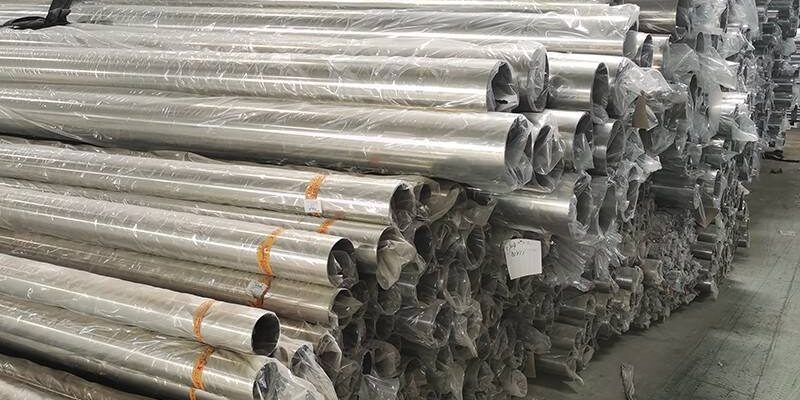
Seamless stainless steel pipe contains at least about 10.5% chromium, which forms a thin protective oxide layer on the surface. This gives it much better corrosion resistance than carbon steel.
The most common grades are austenitic types 304/304L and 316/316L, covered by standards such as ASTM A312. Type 316 contains molybdenum, which improves resistance to chlorides (for example, seawater or salty process fluids). Duplex stainless steels such as UNS S31803/S32205 offer higher strength and better resistance to stress corrosion cracking. Stainless seamless pipe is widely used in chemical and pharmaceutical plants, food and beverage processing, desalination and offshore systems.
Pipe grouped by end use
You will also see seamless products described by what they are for rather than what they are made of:
Boiler and heat-exchanger tubes
- (e.g., ASTM A192, A210, A213)
Line pipe
- for oil, gas and water transmission (API 5L)
OCTG
- — Oil Country Tubular Goods such as casing and tubing for wells (API 5CT)
Mechanical tubing
- for machined parts, cylinders and shafts (e.g., ASTM A519)
Structural hollow sections
- (e.g., EN 10210)
Common Standards and Specifications
A standard tells everyone — mill, buyer, inspector — exactly what the pipe must be: its chemistry, strength, dimensions, tolerances and the tests it must pass. Specifying the right standard is often more important than specifying the steel grade alone.
Frequently used seamless pipe standards
| Standard | What it covers | Typical grades |
| ASTM A106 | Seamless carbon steel pipe for high-temperature service | Gr. A, B, C |
| ASTM A53 | Carbon steel pipe, seamless (Type S) and welded | Gr. A, B |
| ASTM A333 | Pipe for low-temperature service | Gr. 1, 6 |
| ASTM A335 | Seamless ferritic alloy steel pipe for high temperature | P5, P9, P11, P22, P91 |
| ASTM A312 | Seamless and welded austenitic stainless steel pipe | TP304/L, TP316/L, TP321 |
| API 5L | Line pipe for pipeline transportation systems | Gr. B, X42–X70 (PSL1/PSL2) |
| API 5CT | Casing and tubing for oil and gas wells | J55, K55, N80, L80, P110 |
| EN 10216 (parts 1–5) | Seamless steel tubes for pressure purposes (Europe) | P235GH, P265GH, 16Mo3 and others |
| JIS G3454 / G3455 / G3456 | Carbon steel pipe for pressure / high-pressure / high-temperature service (Japan) | STPG, STS, STPT |
| GB/T 8163, GB 5310 | Fluid-service pipe; high-pressure boiler tubes (China) | 10#, 20#, 20G, 12Cr1MoVG |
Note that some standards, such as ASTM A53 and A312, cover both seamless and welded products. If seamless is what you need, say so explicitly on the order (for example, “ASTM A53 Type S”).
Understanding pipe sizes: NPS, OD and schedule
Pipe dimensions can be the most confusing part for newcomers. In the ASME B36.10M (carbon and alloy steel) and B36.19M (stainless steel) dimension standards:
NPS (Nominal Pipe Size)
- is a size label, not a measurement. For NPS 1/8 through NPS 12, the actual outside diameter is larger than the number suggests — NPS 2 pipe, for instance, has an outside diameter of 60.3 mm (2.375 in). From NPS 14 upward, the outside diameter equals the NPS in inches.
DN
- is the metric equivalent label (NPS 2 ≈ DN 50).
Schedule (SCH)
- describes wall thickness. Common schedules include SCH 10, 40, 80 and 160, plus designations such as STD, XS and XXS. For a given NPS, a higher schedule means a thicker wall and a smaller inside diameter, while the outside diameter stays the same.
Hot-finished seamless pipe is typically produced in outside diameters up to roughly 24 inches (610 mm), depending on the mill; larger sizes are usually made by hot expansion or switched to welded pipe. Very thick walls are one area where seamless pipe has a clear advantage.
Key Advantages of Seamless Steel Pipe
No weld seam to worry about. A weld is a region where the metal has been melted and re-solidified, and it can contain small defects. Without a seam, there is no such weak line along the pipe. Design codes reflect this: the ASME B31.3 process piping code, for example, assigns seamless pipe a longitudinal joint quality factor of 1.0, compared with 0.85 for standard ERW (electric resistance welded) pipe. In simple terms, seamless pipe can be credited with its full wall strength in pressure calculations.
Strong performance under pressure and heat. The uniform structure makes seamless pipe well suited to high-pressure steam, hydraulic systems and hot process fluids.
Uniform behavior around the circumference. Since every part of the wall went through the same process, properties such as strength and corrosion resistance are consistent — useful in sour gas service or where the pipe will be bent or formed.
Availability in heavy walls and small diameters. Seamless processes handle thick walls and small, precise sizes that are difficult or uneconomical to weld.
It is worth being balanced, though. Seamless pipe usually costs more than welded pipe of the same size, and its wall thickness is less uniform. ASTM A106, for instance, allows the wall to be as much as 12.5% under the nominal thickness at any point, a tolerance that reflects how the piercing process can leave the bore slightly off-center.
Typical Applications of Seamless Steel Pipe
Seamless pipe is chosen when failure would be costly or dangerous, or when operating conditions are severe. Common applications include:
Oil and gas:
- well casing and tubing, high-pressure flowlines, and portions of pipelines and gathering systems.
Power generation:
- boiler tubes, superheater and reheater tubes, and main steam piping in thermal power plants.
Petrochemical and refining:
- process piping carrying hot hydrocarbons, hydrogen and corrosive chemicals.
Chemical, pharmaceutical and food processing:
- seamless stainless steel pipe for hygienic or corrosive service.
Heat exchangers and condensers:
- tubes that transfer heat between two fluids.
Hydraulics and machinery:
- hydraulic cylinders, high-pressure lines, bearing sleeves, shafts and other machined parts made from mechanical tubing.
Automotive and construction:
- drive shafts, axle housings, and structural hollow sections where strength-to-weight ratio matters.
Seamless vs. Welded Steel Pipe: What’s the Difference?
Welded pipe is made by forming steel strip or plate into a cylinder and joining the edges. The main methods are ERW (electric resistance welding), LSAW (longitudinal submerged arc welding) and SSAW (spiral submerged arc welding). Modern welded pipe is high quality and is used in huge volumes for pipelines, water supply and structural work. The choice between the two depends on the job.
| Feature | Seamless steel pipe | Welded steel pipe |
| Starting material | Solid round billet | Steel strip, coil or plate |
| Weld seam | None | Longitudinal or spiral weld |
| Pressure rating basis (ASME B31.3) | Joint factor 1.0 | 0.85 for ERW; up to 1.0 for some fusion-welded pipe with full radiography |
| Typical size range | Small to medium diameters; heavy walls | Very wide; large diameters (LSAW/SSAW) easily exceed 1,000 mm |
| Wall thickness uniformity | Lower (eccentricity possible) | Higher (made from flat strip of controlled thickness) |
| Surface finish | Hot-finished surface can be rougher; cold-finished is smooth | Generally smooth |
| Cost | Higher | Lower, especially in large sizes |
| Lead time | Often longer, depending on size and grade | Often shorter for standard sizes |
| Typical uses | High pressure/temperature, sour service, boilers, OCTG, hydraulics | Water and gas transmission, structural, low-to-medium pressure piping |
A practical rule of thumb: if the service is high pressure, high temperature, cyclic or corrosive, or if the governing code or client specification calls for seamless, choose seamless. For large diameters, lower pressures and cost-sensitive projects, welded pipe is often the more sensible choice.
Tips for Specifying or Buying Seamless Pipe
If you are preparing an inquiry for the first time, a complete description saves time and avoids misunderstandings. Include:
Product and process
- — e.g., “seamless, hot-finished” or “seamless, cold-drawn”
Standard and grade
- — e.g., ASTM A106 Gr. B, or ASTM A312 TP316L
Size
- — NPS and schedule, or exact OD × wall thickness in mm
Length
- — single random, double random or fixed lengths
End finish
- — plain end, beveled end or threaded
Coating or protection
- — bare, varnished, black painted, or 3LPE for buried pipelines
Testing and documents
- — for example, a mill test certificate to EN 10204 3.1, and any third-party inspection required
Quantity
- — in meters, pieces or metric tons
Asking for the mill test certificate is particularly important: it records the actual chemistry and mechanical test results of the heat of steel used, and lets you check that the material really meets the stated standard.
Frequently Asked Questions
Is seamless pipe always stronger than welded pipe?
Not in terms of the steel itself — a seamless pipe and a welded pipe of the same grade have similar base-metal strength. The difference is that seamless pipe has no weld zone, so design codes generally allow it to be rated at its full wall strength. Welded pipe made and tested to strict standards can also perform very well.
How can I tell if a pipe is seamless?
Check the markings and the mill test certificate, which should state the process (for example, “SMLS” or “Seamless”). Visually, welded pipe often shows a faint weld line, especially on the inside surface, although on high-quality ERW pipe the seam can be hard to see after the weld bead is removed.
What is the difference between ASTM A53 and ASTM A106?
Both cover carbon steel pipe, but A106 is seamless only and intended for high-temperature service, with tighter chemistry and testing requirements. A53 includes both seamless (Type S) and welded (Types E and F) pipe and is commonly used for general and lower-temperature applications. Many mills certify pipe to both standards at once, often together with API 5L.
Which is better, seamless carbon steel pipe or seamless stainless steel pipe?
It depends on the environment. Seamless carbon steel pipe is cheaper and strong, making it a good choice for steam, oil, gas and other non-corrosive fluids. Seamless stainless steel pipe costs more but resists corrosion and is preferred for chemicals, seawater, and hygienic applications such as food and pharmaceuticals.
What does “Schedule 40” mean?
Schedule 40 is a wall-thickness designation. For a given nominal pipe size, it defines a specific wall thickness listed in ASME B36.10M or B36.19M. Wall thickness for Schedule 40 changes from one pipe size to another, so always check the dimension table rather than assuming a fixed value.
Final Thoughts
Seamless steel pipe is not a single product but a family of materials, processes and standards built around one idea: a pipe wall with no weld. That makes it the default choice for many high-pressure, high-temperature and critical services, while welded pipe remains the economical option for large diameters and less demanding work. Understanding the basics — how it is made, which standard applies, and how sizes are expressed — will make it far easier to read specifications, compare quotations and ask the right questions of your supplier.
About Ruixiang Steel
Ruixiang Steel supplies steel pipe to industrial buyers, including seamless carbon steel pipe, alloy steel pipe and seamless stainless steel pipe in a range of sizes and standards. If you’re working through a specification, we can help you confirm the right grade, size and finishing requirements before you request a quote.
When you contact us, please include the standard and grade, OD × wall thickness (or NPS and schedule), length, end finish, quantity and any inspection or certification requirements. With those details, our team can review your requirements and reply with a clear, itemized quotation.
[Contact Ruixiang Steel for a quote →]
This article is intended as general technical background. For any specific project, always follow the governing design code, the project specification and the latest edition of the referenced standards.