H-beam steel is a structural steel section whose cross-section looks like the capital letter “H”: two wide, parallel flanges joined by a vertical web in the middle. This shape puts most of the material where it does the most work—in the flanges, far from the neutral axis—so the beam carries heavy bending loads with relatively low weight. Because the inner and outer faces of the flanges are parallel, H-beams are also easy to bolt, weld, and connect to other members. These qualities make H-beam steel one of the most widely used sections in steel-framed buildings, bridges, industrial plants, and heavy equipment.
This guide explains how H-beams are defined and classified, which standards and grades are commonly specified, how sizes are described in different systems, how the sections are manufactured, where they are used, how they differ from I-beams and other structural shapes, and what to check before buying.
What Is H-Beam Steel?
An H-beam is a long structural member with an H-shaped cross-section. In North America the same product family is usually called a wide flange beam or W-shape; in Europe the closest families are the HE series (HEA, HEB, HEM) and, for narrower profiles, the IPE series; in China and Japan it is commonly referred to as H-section steel. The terms describe sections with parallel flanges, as opposed to traditional I-beams with tapered flanges.
Basic Parts of an H-Beam
Every H-beam is described by four main dimensions:
Height (H or d):
- The overall depth of the section, measured from the outer face of the top flange to the outer face of the bottom flange.
Flange width (B or bf):
- The width of each horizontal flange.
Web thickness (t1 or tw):
- The thickness of the vertical plate that connects the flanges.
Flange thickness (t2 or tf):
- The thickness of each flange.
Hot-rolled sections also have a curved root radius (r) where the web meets the flanges. This fillet reduces stress concentration and adds a small amount of area and weight, which is why published weights are slightly higher than a simple “three rectangles” calculation.
Structural Characteristics
The H shape gives the section a high moment of inertia and section modulus about its strong axis, which means high bending stiffness and strength per kilogram of steel. Wide flanges also improve resistance to lateral-torsional buckling and give the section useful stiffness about its weak axis, which matters for columns. Since the flange faces are parallel and of uniform thickness, connections can use standard flat plates and washers without tapered shims, simplifying fabrication.
Main Types of H-Beams
Many standards group H-sections by the ratio of flange width to height:
Wide flange H-beams (e.g., HW in Chinese standards, HEB/HEM in European practice):
- Flange width close to the section height. Their balanced stiffness about both axes makes them ideal for
columns
, piles, and heavily loaded members.
Medium flange H-beams (e.g., HM):
- Flange width somewhat smaller than the height; used for frames where both bending and axial loads are significant.
Narrow flange H-beams (e.g., HN, or IPE in Europe):
- Flange width roughly one-third to one-half of the height. They are efficient
beams
for floors and roofs where loads act mainly about the strong axis.
Bearing pile sections (e.g., HP):
- Sections with web and flanges of similar thickness, designed for driven foundation piles.
Common Materials, Standards, and Grades
H-beam steel is specified in two parts: a dimensional standard that defines shapes, sizes, and tolerances, and a material standard that defines chemical composition and mechanical properties. Both should appear in any purchase specification.
| Region | Dimensional Standard | Common Material Grades | Min. Yield Strength (typical, thin sections) |
| USA | ASTM A6/A6M (W, HP shapes) | ASTM A992, ASTM A572 Gr.50, ASTM A36 | A992 / A572 Gr.50: 345 MPa (50 ksi); A36: 250 MPa (36 ksi) |
| Europe | EN 10365 (HEA, HEB, HEM, IPE); EN 10034 (tolerances) | EN 10025-2 S235JR, S275JR, S355JR, S355J2 | S235: 235 MPa; S275: 275 MPa; S355: 355 MPa |
| Japan | JIS G3192 | JIS G3101 SS400; JIS G3106 SM490 | SS400: 245 MPa; SM490: 325 MPa |
| China | GB/T 11263 (HW, HM, HN, HT) | GB/T 700 Q235B; GB/T 1591 Q355B | Q235B: 235 MPa; Q355B: 355 MPa |
Note: Minimum yield strength decreases as flange thickness increases in most standards. Always check the value that applies to the actual section thickness.
Mild Carbon Structural Grades
Grades such as ASTM A36, S235JR, SS400, and Q235B are low-carbon structural steels with good weldability and ductility. They are economical and widely used for light and medium structures, secondary framing, platforms, and general fabrication where strength is not the governing factor.
High-Strength Low-Alloy Grades
Grades such as ASTM A992, ASTM A572 Grade 50, S355JR/J2, SM490, and Q355B offer a minimum yield strength of around 325–355 MPa. Small additions of manganese and micro-alloying elements raise strength while keeping carbon equivalent at a weldable level. ASTM A992 is the standard material for wide flange shapes in building construction in the United States, because it also limits the yield-to-tensile ratio and carbon equivalent to support predictable seismic and welding behavior. Using a higher-strength grade often allows a lighter section, which can lower total project weight and cost.
Impact Toughness Sub-Grades
European grade suffixes indicate the Charpy impact test temperature: JR at +20°C, J0 at 0°C, and J2 at −20°C. Chinese Q355 grades use B, C, and D in a similar way. For structures in cold climates, dynamic loads, or thick welded connections, specify a sub-grade with impact testing at a suitably low temperature.
Common H-Beam Sizes and How They Are Designated
Each standard system names H-beams differently. Understanding the naming convention avoids costly ordering mistakes, especially when converting between metric and imperial projects.
| System | Example Designation | Meaning |
| Chinese / Japanese style | H 300 × 150 × 6.5 × 9 | Height 300 mm × flange width 150 mm × web 6.5 mm × flange 9 mm |
| Chinese series prefix | HW 200 × 200 / HN 400 × 200 | Wide flange or narrow flange series, nominal height × flange width |
| American W-shape | W8 × 31 | Nominal depth about 8 inches, weight 31 pounds per foot |
| European HE series | HEB 200 | HE series, B-weight profile, nominal size 200 |
| European IPE series | IPE 300 | Narrow parallel-flange beam, nominal height 300 mm |
Typical Size Ranges
Height:
- Hot-rolled H-beams are commonly available from about
100 mm to 900 mm
in height, with some mills rolling deeper sections. Very large or unusual profiles are usually supplied as welded H-beams.
Flange width:
- From about
50 mm to 400 mm
or more, depending on the series.
Web and flange thickness:
- From about
5 mm to over 40 mm
across the full range of rolled sections.
Length:
- Standard stock lengths are typically
6 m and 12 m
. Other fixed lengths can often be cut or rolled to order, subject to mill capacity and transport limits.
Estimating Weight per Meter
For quick checks, the weight of an H-beam can be estimated from its plate dimensions and the density of steel (7.85 g/cm³):
Weight (kg/m) ≈ [2 × B × t2 + (H − 2 × t2) × t1] × 0.00785
where all dimensions are in millimeters. For a section of H 200 × 200 × 8 × 12:
Area ≈ 2 × 200 × 12 + (200 − 24) × 8 = 4,800 + 1,408 = 6,208 mm²
Weight ≈ 6,208 × 0.00785 ≈ 48.7 kg/m
The weight listed in standard tables is slightly higher because the formula ignores the root fillets. For quotations, design, and freight planning, always use the theoretical weight given in the applicable standard table.
How H-Beam Steel Is Manufactured
H-beams are produced either by hot rolling in a dedicated section mill or by welding steel plates together. Each route has its own advantages.
Hot-Rolled H-Beams
Most standard H-beams are hot rolled. The process typically follows these steps:
Steelmaking and casting:
- Steel is produced in a basic oxygen furnace or electric arc furnace, refined in the ladle, and cast into
beam blanks
(near-net “dog-bone” shapes) or rectangular blooms.
Reheating:
- The blanks are reheated to roughly 1,200°C so they can be deformed easily.
Breakdown rolling:
- A breakdown mill roughs the blank toward the H shape.
Universal rolling:
- The section passes through a
universal mill
, which uses two horizontal rolls to shape the web and two vertical rolls to shape the flanges at the same time. This is what produces parallel flanges with uniform thickness.
Finishing, cooling, and straightening:
- A finishing stand sets final dimensions, then the beams are cooled on a cooling bed and straightened in a roller straightener.
Cutting and inspection:
- Beams are sawn to length, inspected for dimensions and surface quality, marked, and bundled.
Hot-rolled sections have consistent properties, smooth root fillets, and no welds, which makes them cost-effective for standard sizes ordered in large quantities.
Welded (Built-Up) H-Beams
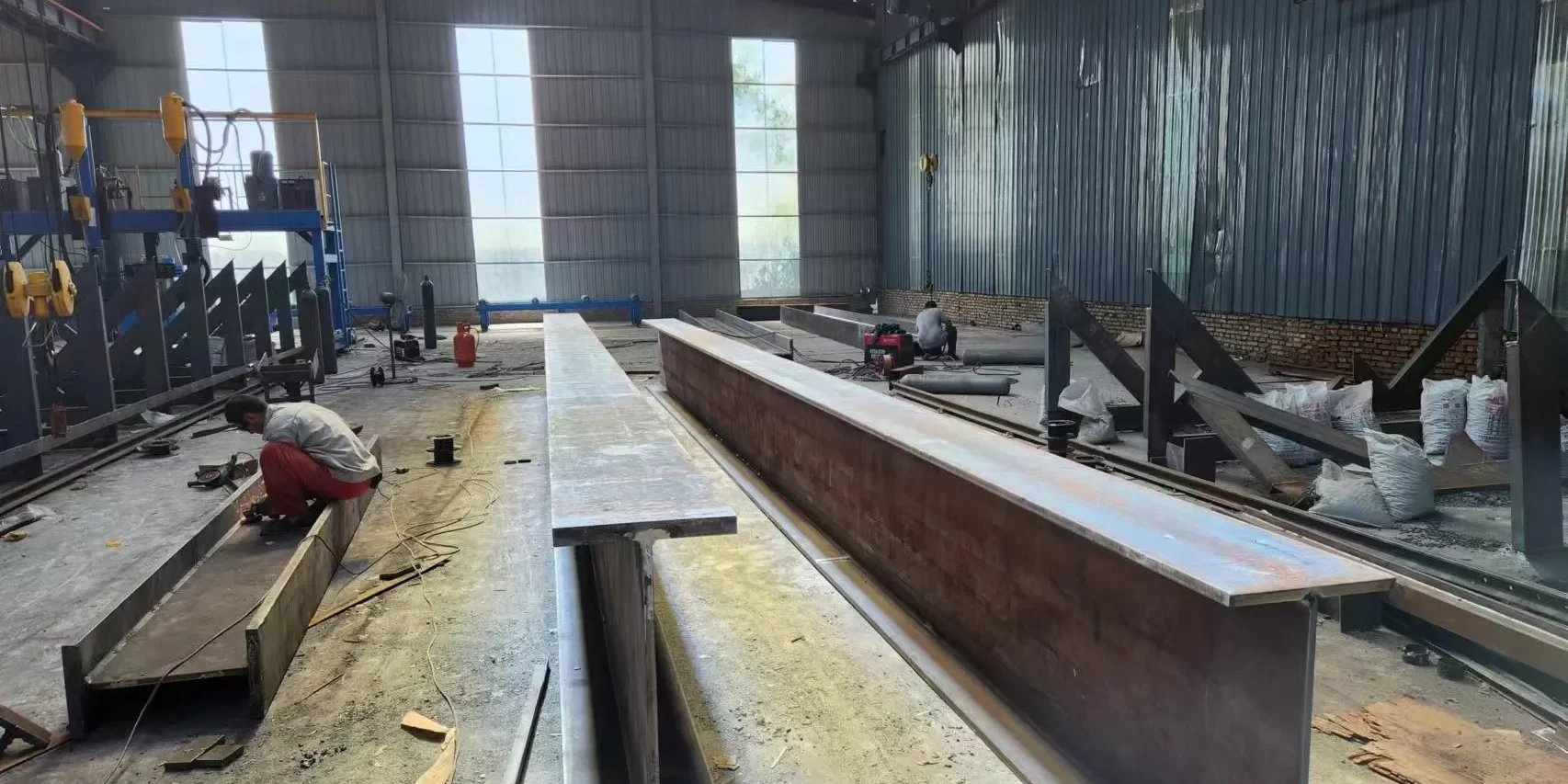
Welded H-beams are fabricated from steel plates. The flanges and web are cut from plate, assembled on an H-beam assembly machine, and joined with fillet welds, usually by submerged arc welding. The beam is then straightened to correct flange distortion caused by welding.
Welded H-beams are used when a project needs sizes outside the rolled range, very deep girders, unequal flanges, tapered webs, or a specific plate grade. They offer great flexibility in design but involve more fabrication labor and require weld inspection.
Surface Treatment and Secondary Processing
H-beams may be supplied in the as-rolled condition (with mill scale) or with additional treatments such as shot blasting and primer painting, hot-dip galvanizing, or fire-resistant coating. Common secondary processing includes cutting to length, drilling, coping, beveling, and cambering. These services are usually agreed separately from the base material price.
Key Performance Advantages of H-Beam Steel
H-beam steel is chosen for practical engineering reasons rather than tradition alone:
High strength-to-weight ratio:
- The wide flanges place material far from the neutral axis, giving high bending capacity per kilogram of steel. This reduces dead load on foundations and supporting members.
Good stability as columns:
- Wide flange sections have useful stiffness about both axes, which improves resistance to buckling when carrying axial loads.
Easy connections:
- Parallel flanges allow simple bolted and welded connections using standard flat plates, angles, and end plates. Tapered washers are not needed.
Fast construction:
- Standardized sizes can be prefabricated in a workshop and erected quickly on site, shortening construction schedules compared with cast-in-place concrete.
Design flexibility:
- A large catalogue of rolled sizes, plus welded options, lets engineers match section size closely to load requirements.
Predictable quality:
- Hot-rolled sections are produced to standardized dimensions, tolerances, and mechanical properties, supported by mill test certificates.
Recyclability:
- Structural steel can be recovered and recycled at the end of a building’s life, and steel members can sometimes be reused.
There are also limitations to consider. Exposed steel needs corrosion protection, and structural steel loses strength at high temperatures, so fire protection is often required in buildings. These factors should be included in project cost comparisons.
Applications of H-Beam Steel
Because it handles both bending and compression efficiently, H-beam steel appears in almost every sector of construction and heavy industry:
Commercial and residential buildings:
- Columns, primary floor beams, transfer girders, and roof framing in steel-framed offices, shopping centers, hotels, and high-rise buildings.
Industrial buildings and warehouses:
- Portal frames, crane runway beams, mezzanine floors, and storage platforms.
Bridges and infrastructure:
- Short- and medium-span bridge girders, pedestrian bridges, highway sign structures, and elevated walkways.
Foundations and earthworks:
- HP bearing piles, soldier piles for excavation support, and reinforcement for retaining structures.
Energy and process plants:
- Pipe racks, equipment supports, boiler steel structures, and frames for power plants, refineries, and chemical facilities.
Transportation and machinery:
- Truck and trailer chassis, railway vehicle frames, shipbuilding components, and heavy equipment bases.
Renewable energy and utilities:
- Solar farm support structures, substation frames, and transmission equipment platforms.
In each case, the section series is chosen according to function: wide flange profiles for columns and piles, narrow flange profiles for beams spanning floors and roofs.
H-Beam vs. I-Beam and Other Structural Steel Sections
H-beams are often compared with I-beams, channels, and hollow sections. The right choice depends on load type, span, connection details, and cost.
H-Beam vs. I-Beam
The terms are sometimes used loosely, but in steel standards there are clear differences:
| Feature | H-Beam (Wide Flange) | Traditional I-Beam (Tapered Flange) |
| Flange shape | Parallel inner and outer flange faces, uniform thickness | Inner flange faces sloped (typically about 1:6), thicker near the web |
| Flange width | Wide; can be close to section height | Narrow relative to height |
| Weak-axis stiffness | Higher, especially in wide flange series | Lower |
| Use as column | Very suitable | Less suitable due to low weak-axis stiffness |
| Connections | Simple flat plates and standard washers | Often needs tapered washers or shims |
| Size range | Large range, including very deep sections | Generally more limited |
| Typical uses | Building frames, columns, bridges, piles | Light beams, crane rails, trolley tracks, secondary members |
In short, a traditional I-beam is mainly a bending member, while an H-beam can work efficiently as both a beam and a column. Narrow parallel-flange profiles such as IPE are sometimes called I-beams, but they share the parallel-flange geometry of the H-beam family.
H-Beam vs. Channel Steel
Channel steel (C or U sections) has a single web with flanges on one side only. It is lighter and convenient for framing, purlins, and trimming openings, but its shear center lies outside the section, so it tends to twist under load unless braced or used in pairs. H-beams are symmetrical and carry heavier loads more efficiently.
H-Beam vs. Hollow Structural Sections
Square and rectangular hollow sections offer excellent torsional resistance and a clean appearance, making them popular for columns, trusses, and architectural structures. However, connections to hollow sections can be more complex, and their bending efficiency over long spans is generally lower than that of a deep H-beam of similar weight.
Hot-Rolled vs. Welded H-Beams
Hot-rolled H-beams are usually more economical for standard sizes and have no welds to inspect. Welded H-beams cost more to fabricate per tonne but allow non-standard dimensions, deeper girders, and flexible plate grades. Many projects combine both: rolled sections for standard members and welded girders where spans or loads are exceptional.
How to Choose and Buy H-Beam Steel
A complete and accurate specification is the best way to get comparable quotations and avoid problems during fabrication or inspection. Before sending an inquiry, confirm the following:
Dimensional standard and exact section:
- State the standard and designation, for example
W12 × 26 to ASTM A6
or
HEB 300 to EN 10365
. Do not assume that a similar-looking size in another standard is identical; dimensions and weights often differ.
Material grade and sub-grade:
- Specify the full grade, such as
ASTM A992
,
EN 10025-2 S355J2
, or
GB/T 1591 Q355B
. Include impact test requirements where the structure faces low temperatures or dynamic loads.
Length and quantity:
- Confirm whether you need standard stock lengths or fixed cut lengths, and give quantity by both pieces and tonnage. Clarify whether pricing is based on theoretical weight or actual weighed weight.
Tolerances:
- Agree on the tolerance standard for height, flange width, thickness, straightness, and squareness (for example ASTM A6 or EN 10034). Tight tolerances matter for prefabricated connections.
Mill test certificates:
- Request certificates to EN 10204 type 3.1 (or 3.2 if third-party witnessing is required) showing chemical composition, tensile results, and impact values traceable to heat numbers marked on the beams.
Surface condition and processing:
- Specify whether beams are supplied as-rolled, shot blasted and primed, or galvanized, and list any cutting, drilling, or coping needed. These are usually negotiable services agreed before order confirmation.
Packing, marking, and transport:
- Long H-beams require careful bundling, marking, and loading. Confirm bundle weights, labeling requirements, and whether lengths suit container or break-bulk shipping.
When in doubt about section selection or grade substitution, consult the structural engineer responsible for the project before finalizing the order.
Frequently Asked Questions About H-Beam Steel
What is the difference between an H-beam and a W-beam?
They describe the same family of parallel-flange sections. “W-beam” or “wide flange” is the common term under American standards, while “H-beam” is widely used in Asian and international trade. However, the exact dimensions of an American W-shape and an Asian or European H-section of similar size are not identical, so always order by the specific standard and designation.
Can H-beams be used as columns?
Yes. Wide flange H-beams, with flange width close to the section height, are among the most common column sections in steel buildings because they have good stiffness about both axes and simple beam-to-column connections. Narrow flange sections are generally more efficient as beams than as columns.
Which material grade is most common for H-beam steel?
It depends on the market. ASTM A992 is standard for wide flange shapes in US building construction, S275 and S355 grades are common in Europe, SS400 and SM490 are common in Japan-based specifications, and Q235B and Q355B are widely used under Chinese standards. Higher-strength grades often allow lighter sections.
Are welded H-beams as strong as hot-rolled H-beams?
A properly designed and fabricated welded H-beam can meet the same structural requirements as a hot-rolled section, provided the plate material, weld procedures, and weld inspection are appropriate. Hot-rolled sections are usually more economical for standard sizes, while welded sections are preferred for non-standard dimensions and very deep girders.
How are H-beams protected against corrosion?
Common methods include shot blasting followed by primer and paint systems, and hot-dip galvanizing for outdoor or humid environments. The choice depends on the exposure conditions, required service life, and whether the beams will also need fire protection.
Conclusion
H-beam steel is a versatile and efficient structural section that combines high bending strength, good column stability, and simple connection details. Its parallel wide flanges set it apart from traditional tapered-flange I-beams and make it a preferred choice for building frames, bridges, industrial structures, foundations, and heavy equipment.
Choosing the right H-beam involves more than picking a size. Engineers and buyers should specify the correct dimensional standard and section designation, select a material grade and impact sub-grade suited to the loads and climate, confirm tolerances and test certificates, and plan surface protection and processing in advance. With a clear specification, H-beam steel delivers reliable performance, fast construction, and good overall cost efficiency across the full life of the structure.
If you are planning a project that uses H-beam steel, share your required standard, section sizes, material grade, lengths, and quantities with our sales and technical team for a tailored recommendation and quotation.